Hi! My name is MacKenzie Ludgate and I am a 4th year medical student at the Northern Ontario School of Medicine and have the opportunity to contribute to Dr. Sharp’s blog!
May 31st is World No Tobacco Day so I thought it was a good topic to dicuss. Smoking cigarettes is the most common form of tobacco use worldwide. Cigarettes are highly addictive; they kill up to half of its users, which equates to roughly 8 million people each year. The direct and indirect economic costs of tobacco are significant. These expenses include medical care, fire damage, law enforcement activities, and lost productivity from those who smoke and those affected by second hand smoke. Unfortunately, few people fully understand the detrimental health risks of tobacco use, however when they do, most want to quit. Smoking increases the risk of developing ischemic heart disease (restricting the blood supply and oxygen to your heart), stroke (poor blood flow to the brain resulting in brain cell death), chronic obstructive pulmonary disease (long term breathing problems, with poor airflow and typically worsens overtime) and lung cancer.
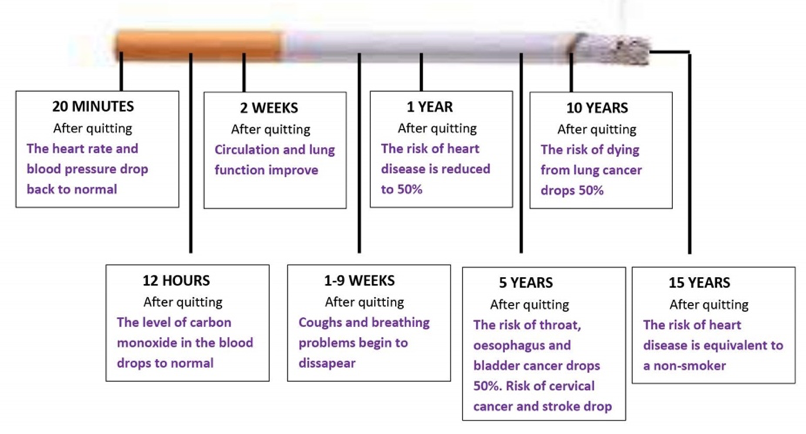
I remember early in my education training, I was presented this diagram which displays the benefits of stopping smoking. It is pretty remarkable how your body can begin to heal even after just 20 minutes!
Trying to stop smoking without support can be done but it is often difficult and stressful. Using supportive therapy more than doubles your chances to stop smoking. Supportive therapy includes the following:
👉If you tend to smoke after a meal – chew gum, get up from the table right away or start a new activity after meals like going for walks
👉If you smoke while drinking alcohol, either avoid alcohol when first starting to quit or drink something without alcohol like cranberry juice and soda water.
👉Tell your friends and co-workers you are trying to quit or cutting back
👉If feeling stressed, call a friend or try writing in journal
👉Keep your hands busy when you are talking (use a stress ball, doodle with a pen and paper)
Nicotine replacement therapy (sometimes known as NRT) is the first-choice physicians choose when helping patients stop smoking. It is safe to use in all patients, including people with heart disease. There are several different options and we hope to simplify your choices.
- Patch
- Lozenge
- Gum
- Inhaler
- Oral mist
The patch is the only long acting form of nicotine replacement, lasting 24 hours. The rest are short acting. Based on what you like best, one form is tried first or the patch can be tried with a short acting form. If nicotine replacement therapy is ineffective it may be worthwhile to start a prescription medication or combining with nicotine replacement therapy.
Prescription products include:
· ChampixⓇ (Varenicline)
· ZybanⓇ (Wellbutrin)
There are advantages and disadvantages to each form, so if you have any questions, please speak with your medical provider for counselling and further advice on how to quit! You are not in this alone.
LEARN MORE:https://www.ontario.ca/page/support-quit-smoking
ALGOMA RESOURCES: http://www.algomapublichealth.com/addictions-mental-health/tobacco/
References
Triggers and Cues. Centre for Addiction and Mental Health. 2019. Retrieved from: https://www.nicotinedependenceclinic.com/en/Pages/Triggers-Cues.aspx
Tobacco Free Initiative. World Health Organization. 2020. Retrieved from: https://www.who.int/tobacco/communications/en/
Smoking Cessation Drug Therapy. Canadian Pharmacist Letter. Feb 2019. Retrieved from: https://ca-pharmacist.therapeuticresearch.com/Content/Segments/PRL/2016/Jul/Smoking-Cessation-Drug-Therapy-10354*Subscription only
 Dr. Lorraine Sharp
I generally check this kind of article and I found your article which is related to my interest. Genuinely, it is good and instructive information about smoking. Thanks for sharing an amazing article here.online headshop in USA
LikeLike